MPs reject assisted dying bill after tense debate – as it happened
The bill would have allowed terminally ill adults with less than six months to live to end their lives, after the approval of a panel of experts MPs vote against legalising assisted dying in England and Wales While the debate continues, we have a comment from Sam Royston, executive director of research and policy at Ma
From
2h agoMPs vote against assisted dying bill
MPs have voted against legislation that would have allowed terminally ill adults in England and Wales, with six months or less to live, to seek medical assistance to end their lives.
The bill was defeated by 286 votes to 270, a majority of 16.
The result represents a setback for supporters of assisted dying, after MPs backed the legislation by 314 votes to 291 in the previous Commons vote in June 2025.
The bill will not proceed in its current form following the Commons vote.
Key events
9m ago
Closing summary
2h ago
MPs vote against assisted dying bill
5h ago
Terminally ill people are already travelling abroad to seek assisted death, says Benn
5h ago
'Mental capacity and mental health are not the same thing,' says Labour MP
6h ago
Labour MP says terminally ill mother chose to end her life after 'screaming in pain for weeks'
6h ago
Zubair Ahmed: 'Social and palliative care system is not ready for assisted dying'
6h ago
Green party the 'underdog' of Holborn and St Pancras byelection, says Polanski
6h ago
Polanski announced as Green party's candidate for Holborn and St Pancras byelection
7h ago
Badenoch urges caution over 'badly drafted' assisted dying bill
7h ago
'Government must fix the crisis in palliative care,' says Marie Curie
7h ago
Assisted dying bill sponsor opens debate with criticism of Lords
8h ago
Watch: Commons debate on assisted dying bill
8h ago
Esther Rantzen now ‘too physically fragile’ to end her life in Switzerland
8h ago
Assisted dying bill returns to the Commons
Closing summary
A bill to permit assisted dying in England and Wales has been voted down by MPs, almost certainly stopping such a measure from being enacted before the next general election at the very least least. In the second reading of the bill, put forward by Labour’s Lauren Edwards, MPs voted by 286 to 270 for it to be blocked.
The result is a reversal of MPs’ support for a near-identical version of the bill, which sought to allow adults with terminal illnesses and less than six months to live to end their lives with the approval of a panel of experts. This was approved by the Commons in the last parliament.
In a statement after the vote, Edwards said the public broadly supported a change in the law and “will not understand why that couldn’t happen because a minority in the House of Lords used procedural devices to block it and MPs balked at insisting that they do their job”. She added: “Assisted dying will come in this country, as it is already doing all across the world, but not soon enough. Parliament has dropped the ball today. It will be picked up again as it must be, because the law as it stands is simply too cruel and too unjust to be allowed to stand.”
Three Labour MPs who opposed the assisted dying bill have warned it is “not a moment for celebration”, as they called on the government to “sort out social and palliative care”. In a statement following the Commons vote, Ashley Dalton, Meg Hillier and Jess Asato said: “MPs have voted against this bill because it wasn’t an abstract debate but a decision about a real bill that was unsafe and unworkable. But this is not a moment for celebration, we understand the deep concerns of so many people across the country who have campaigned hard for a change in the law.”
The disability rights group Assist Us To Live said today’s vote was “a victory for disabled people, terminally ill people, and everyone this bill would have put at risk”. In a statement, the group said: “As disabled people, we fight every day just to get support to eat, wash, leave our homes, and work, while palliative and social care systems remain dangerously underfunded. We thank MPs for assisting us to live, and we’re ready to work with government to deliver the reforms we’ve been demanding.”
Essex county council’s Reform UK leader Peter Harris has been accused by Conservative Tom Cunningham of “stoking division” over plans for a private security force to patrol near a former military base housing hundreds of asylum seekers. Cunningham, the leader of Braintree district council, said Harris was taking a “confrontational approach” with the controversial three-month security trial to “protect” local residents near MDP Wethersfield, a former military base situated outside the village of the same name in north Essex.
Zack Polanski has said a vote for him in the upcoming Holborn and St Pancras byelection is a vote against the government’s reported plans to greenlight a North Sea gasfield. The leader of the Green party in England and Wales, who was selected on Friday to contest the London seat, also said he was considering building a personal stockpile for the extreme weather predicted with the arrival of the biggest El Niño in 1,000 years, a meteorological phenomenon that supercharges floods and droughts.
Ofcom has warned broadcasters they must comply with the rules for election-related programming ahead of the by-election in Holborn and St Pancras on 8 October. The election is due to be held following the resignation of former prime minister Keir Starmer from the House of Commons on 1 September.
Former prime minister Gordon Brown has called for decision-makers to “radically improve end of life care”, after MPs voted down the Terminally Ill Adults (End of Life) Bill.
Brown wrote on X:
I hope we can all now come together to radically improve end of life care.
MPs today voted not to approve the assisted dying bill at its second reading.
The bill, which was brought back to the Commons after being blocked in the Lords, would have allowed terminally ill people to end their lives with medical help in some circumstances.
Find out how your MP voted …
The Archbishop of Liverpool and lead bishop for life issues in the Catholic Bishops’ Conference of England and Wales thanked people who wrote to MPs to stop the bill.
Archbishop John Sherrington said:
Throughout this debate, we have argued that our response to those facing serious illness, disability or the challenges of old age should be rooted in solidarity, care and respect.
The true measure of a compassionate society is its willingness to support people through difficult circumstances rather than encouraging them to end their lives.
He added:
We remain convinced that the most effective way to address suffering at the end of life is through greater access to excellent palliative and end-of-life care.
Ensuring such care is available to all who need it can help people experience comfort, dignity and support in their final days. We will continue to promote these as priorities and to stand alongside those who devote themselves to caring for the dying in hospices, hospitals, care homes and communities.
Three Labour MPs who opposed the assisted dying bill have warned it is “not a moment for celebration”, as they called on the government to “sort out social and palliative care”.
In a statement following the Commons vote, Ashley Dalton, Meg Hillier and Jess Asato said:
MPs have voted against this bill because it wasn’t an abstract debate but a decision about a real bill that was unsafe and unworkable.
But this is not a moment for celebration, we understand the deep concerns of so many people across the country who have campaigned hard for a change in the law.
But the truth is none of the relevant royal medical colleges, professional groups or experts will attest to the safety or workability of this bill.
The PM is right; we must fix our NHS and sort out social and palliative care before we even consider introducing assisted dying.
The rejection of assisted dying legislation is “hugely disappointing”, the bill’s sponsor Lauren Edwards said.
She accused parliament of having “dropped the ball” and described the current law as “simply too cruel and too unjust to be allowed to stand”.
She added:
This is a hugely disappointing result – not for me but for the many thousands of terminally ill people and their loved ones who were given hope when the Commons voted for this bill last year.
It is all the more heartbreaking for them because support for choice at the end of life is still as strong in parliament as it was before. The objections raised today were not about the principle of assisted dying but about parliamentary process.
The public, who strongly support a change in the law, will not understand why that couldn’t happen because a minority in the House of Lords used procedural devices to block it and MPs baulked at insisting that they do their job.
Assisted dying will come in this country, as it is already doing all across the world, but not soon enough.
Parliament has dropped the ball today. It will be picked up again as it must be, because the law as it stands is simply too cruel and too unjust to be allowed to stand.
Diane Taylor
Further to our earlier report on the row between Reform UK and the Conservatives over security patrols near a military base housing asylum seekers (see post at 12:28), we have a comment from Peter Harris, leader of Essex county council.
He said: “Operation Vanguard is a positive and proportionate response to the concerns residents have been raising for many months now regarding the daily bussing of asylum seekers from Wethersfield to Braintree, Colchester and Chelmsford.
“Concerns for community safety are clearly there, particularly among women and girls, because of the daily gatherings of asylum seekers – gatherings which will increase in number and size as the facility expands.”
The disability rights group Assist Us To Live said today’s vote was “a victory for disabled people, terminally ill people, and everyone this bill would have put at risk”.
In a statement, the group said: “As disabled people, we fight every day just to get support to eat, wash, leave our homes, and work, while palliative and social care systems remain dangerously underfunded.
“We thank MPs for assisting us to live, and we’re ready to work with government to deliver the reforms we’ve been demanding.”
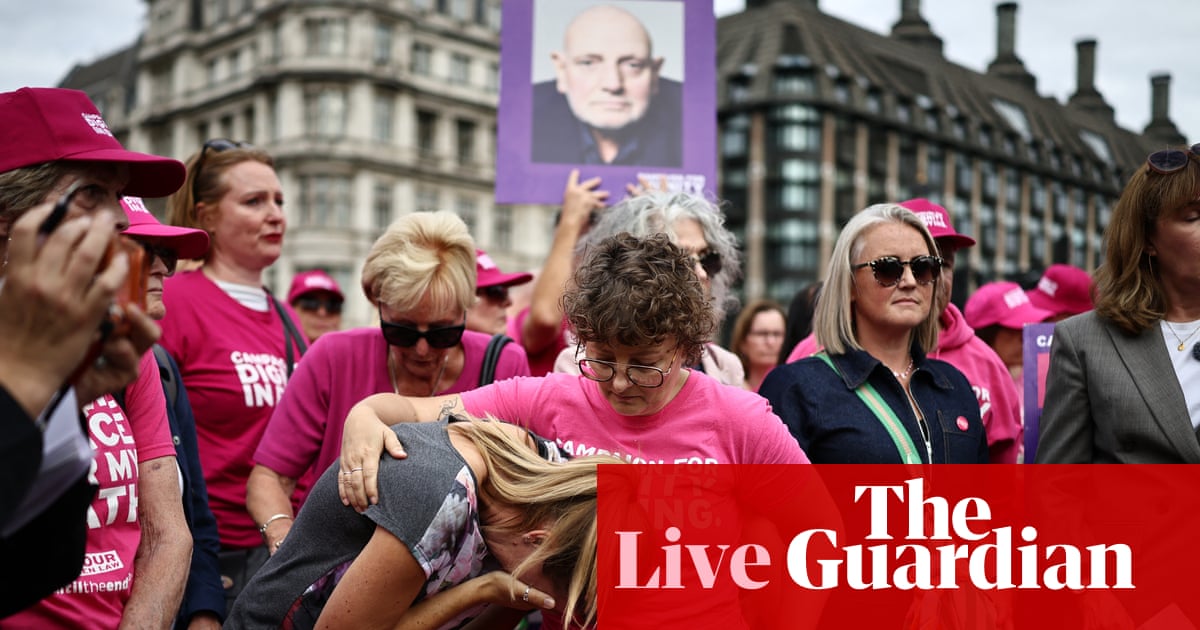
Assisted dying campaigners react in front of parliament after MPs voted down the bill:
Photograph: Jack Taylor/ReutersWe have some reaction from charities on the Commons vote, after MPs rejected a draft law to legalise assisted dying in England and Wales.
Toby Porter, CEO of Hospice UK, said:
We recognise that today’s vote will be deeply disappointing for those who have supported a change in the law. But there is so much that can be done to improve choice at the end of the life by investing in end of life care, including funding to hospices. This would dramatically improve the choices available to the 150,000 people in England and Wales who currently do not receive the palliative care they need.
Right now nearly 60% of hospices in England have made, or are considering, cuts to frontline services at a time when demand is growing. This means more and more people are going without the care and support they need.
While the proposed legislation on assisted dying will not progress, as a society we must not lose focus on the urgent need to fix the hospice funding crisis. Opponents and supporters of the bill must now channel their energy and passion into fixing it, to ensure everyone can get the end of life care they need.
The prime minister has recently stated the need to fix palliative care funding. His support is welcome, but his words must now be accompanied by meaningful action.”
Steve Smith, CEO of St Christopher’s Hospice, said:
Today’s vote does not change the urgent need to improve funding for hospice and palliative care.
Whatever the future of the assisted dying debate, everyone approaching the end of life should be able to access high-quality care, wherever they live and regardless of their circumstances.
St Christopher’s remains neutral on whether the law should change, but the government must now follow through on the cross-party recognition of the pressures facing hospices by delivering fair, sustainable and consistent funding before more services are forced to close or cut back.”